

Linework: the work, the crew, how to get on
Updated
The Good
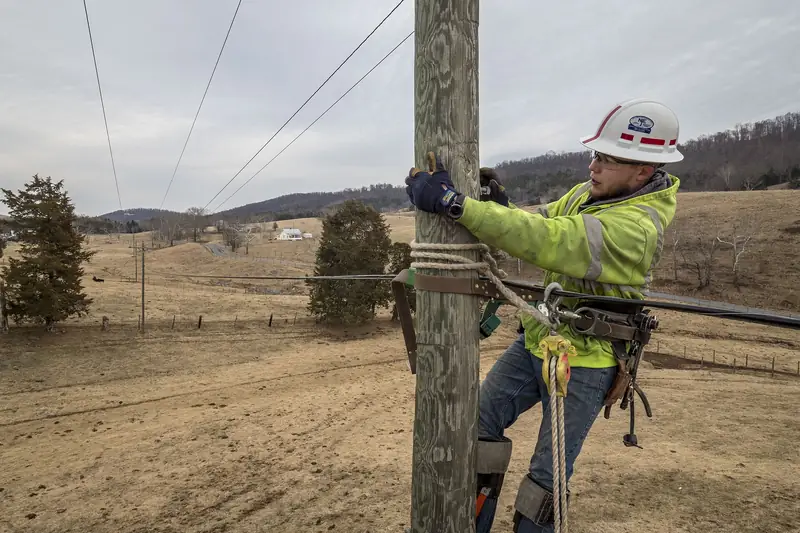
When the storm takes the lines down, linemen go up. Trust on the pole is earned the slow way, one job at a time, by people who watch each other work.
- They install or repair cables or wires used in electrical power or distribution systems. 3
The work keeps coming: BLS projects employment to grow 10.3% from 2025 to 2035, with about 10,900 openings a year 2
If you served
Military jobs that map here 5
- Army MOS: 12Q Powerline Distribution Specialist (RC)
- Navy rating: CE Construction Electrician; EM Electrician's Mate
- Air Force AFSC: 3E0X1 Electrical Systems
- Marine Corps MOS: 1141 Electrician
- Coast Guard rating: EM Electrician's Mate
Is it for you?
You fit if heights do not bother you, you can work in sleet at midnight and you follow procedure even when nobody is watching. Line crews have no use for cowboys.
A day on the crew
A typical day as crews describe it. Every outfit runs its own way.
- The day starts at the tailboard. The foreman walks the job, the hazards and who does what, and every man signs off.
- Trucks roll to the site. The groundman sets cones, chocks the wheels and lays out hardware before anyone asks.
- Up top, the linemen work from the bucket or on hooks. Below, the groundman sends up tools and material on the handline and keeps the drop zone clear.
- Poles get set, wire gets pulled and sagged, and the crew checks every connection twice.
- Cleanup, load out and a short talk about what went right and what did not. Storm season, you may do it again tomorrow two counties over.
Storm work means time away. Talk it through at the kitchen table before the first call-out, so the people waiting at home know the plan.
The Brutal
Storm calls do not wait for a good night's sleep. You work in the cold and the heat, long hours when the lines are down, and near live conductors there is no room for a careless minute.
- 93% of surveyed workers report daily exposure to hazardous conditions and 83% work in high places daily. 3
- 59% report a typical work week of more than 40 hours, and workers travel to work sites. 3
Crew safety talks for this trade: fall protection · electrical and lockout. Free, with a printable sign-in sheet.
Greenhorn mistakes
- Walking under the bucket or the pole to save a few steps.
- Sending up the wrong part because you did not learn the hardware names.
- Treating the tailboard like a formality and tuning out.
Hard lessons
Every lineman remembers the day he was too slow on the ground and heard about it. The good ones took the chewing, learned the hardware and were faster the next morning. Getting corrected is not the end of you. It is how the crew keeps you alive.
The Paycheck
The spread: 10% of electrical power-line installers and repairers earned under $51,470, 10% over $128,690 1 BLS does not publish starting pay, overtime or per diem, so neither do we. Get the rate and travel terms in writing.
U.S. pay, BLS OEWS May 2025 national estimatesOccupation · Median. Tap a row for the rest.
Electrical power-line installers and repairers$95,320 ($45.83/hr)
- Median
- $95,320 ($45.83/hr)
- Bottom 10%
- $51,470
- Top 10%
- $128,690
- Jobs
- 131,070
- Code
- SOC 49-9051
Base wages 1
Where the pay runs highest
Top five states by median wage, BLS OEWS May 2025State · Median · vs U.S. median. Tap a row for the rest.
Hawaii$134,340 · +41%
- Median
- $134,340
- vs U.S. median
- +41%
- Jobs
- 600
Washington$133,060 · +40%
- Median
- $133,060
- vs U.S. median
- +40%
- Jobs
- 2,340
Oregon$131,090 · +38%
- Median
- $131,090
- vs U.S. median
- +38%
- Jobs
- 1,640
California$129,040 · +35%
- Median
- $129,040
- vs U.S. median
- +35%
- Jobs
- 8,930
Connecticut$126,850 · +33%
- Median
- $126,850
- vs U.S. median
- +33%
- Jobs
- 940
Of 51 ranked 1
How to Get In
Ask any line contractor or utility about groundman openings. The groundman works the ground end of a line crew, and that is one place to learn it.
Crews hire who they know. Here is how to get known and get hired.
What the foreman wants to see
- You stay out of the drop zone without being told.
- The next piece of material is ready before the lineman calls for it.
- You ask what something is called, write it down and do not ask twice.
Before Monday, ask what the job needs: a license or permit, a CDL class, a safety card or site orientation, a drug screen. Gear: the Day One checklist.
- Usually a high school diploma or GED plus a few days to a year of on-the-job training; registered apprenticeships exist. 3
- Federal rule defines the Group B heavy straight vehicle as a single vehicle with a GVWR of 26,001 pounds or more, which may tow a trailer of up to 10,000 pounds GVWR. 6
The full federal CDL, medical card and training rules are on the truck driving page.
Apprenticeship sponsors
DOL lists 140 sponsors matched to this trade by name, most in Idaho 61, Kansas 10, Texas 9, Florida 7, Washington 7. A place to start calling, not a job count 8
The path to owning your own outfit
Line work mostly runs through utilities and line contractors, not one-truck outfits. The path up is usually crew leader, foreman, then general foreman. Some go on to run their own contracting company after many years of field time. BLS puts the self-employed share of electrical power-line installers and repairers at 0.3% in 2025 7. The full steps are on crew to owner.
Where the build is
Generators under construction and planned, by state (EIA-860M, Sept 2026)State · Building. Tap a row for the rest.
TX20,183 MW
- Units building
- 106
- Building
- 20,183 MW
- Units planned
- 379
- Planned
- 62,267 MW
CA6,372 MW
- Units building
- 98
- Building
- 6,372 MW
- Units planned
- 88
- Planned
- 11,508 MW
AZ5,398 MW
- Units building
- 37
- Building
- 5,398 MW
- Units planned
- 32
- Planned
- 8,792 MW
WY3,550 MW
- Units building
- 4
- Building
- 3,550 MW
- Units planned
- 13
- Planned
- 3,656 MW
VA3,499 MW
- Units building
- 23
- Building
- 3,499 MW
- Units planned
- 38
- Planned
- 3,816 MW
Jobsite words
- Tailboard
- The pre-job safety talk at the truck before work starts.
- Groundman
- The crew member who works the ground end of the job and supports the linemen.
- Hot stick
- An insulated pole used to work on or near energized lines.
- Handline
- The rope used to raise and lower tools and material to the lineman.
More in the jobsite words glossary.
Questions people ask
How many people work as electrical power-line installers and repairers?
BLS OEWS counted 131,070 in May 2025 (data released May 15, 2026).
What training does it take?
BLS lists the typical entry education as high school diploma or equivalent and the typical training as long-term on-the-job training (Employment Projections 2025-35).
How much do electrical power-line installers and repairers make?
BLS OEWS reported a May 2025 median of $95,320 a year, or $45.83 an hour, with the bottom 10% at $51,470 and the top 10% at $128,690 (data released May 15, 2026).
What do greenhorns get wrong?
Walking under the bucket or the pole to save a few steps. Sending up the wrong part because you did not learn the hardware names. Treating the tailboard like a formality and tuning out. You stay out of the drop zone without being told.
Running a linework crew?
Featured hiring spots open soon; seekers apply straight to you.
Tell us you are hiringOther trades
Sources
- BLS OEWS, May 2025 data, released May 15, 2026
- BLS Employment Projections 2025-35, 2025-35 projections
- O*NET OnLine: Electrical Power-Line Installers and Repairers, page dated Oct 6, 2026
- BLS OEWS, May 2025: national mean and 90th percentile annual wage, May 2025 data, released May 15, 2026
- O*NET OnLine Military Crosswalk, vintage Oct 30, 2026
- 49 CFR 383.91, Cornell LII, checked Nov 19, 2026
- BLS Employment Projections Table 1.2, percent self-employed, 2025 data
- U.S. DOL Office of Apprenticeship partner sponsors, trades-core release Nov 4, 2026
- EIA Form EIA-860M, September 2026 inventory, released Oct 23, 2026
- Technology-to-trade mapping, Tough and Dirty (editorial, not an EIA or BLS product), Nov 2026
Estimates, not promises. Rules change; check with the employer and the agency.
Photos: Lineworker climbing a pole, U.S. Department of Agriculture Preston Keres/Office of Communications-Photography Services Center, Public domain. All photo credits.
