

Electrician: the work, the crew, how to get on
Updated
The Good
Electricians keep the lights on, and the crew counts on you to get it right the first time. This is exacting work done by hand, and the respect that comes with it is earned in the field.
- Electricians install, maintain and repair electrical power, communications, lighting and control systems. 3
The work keeps coming: BLS projects employment to grow 9.2% from 2025 to 2035, with about 72,700 openings a year 2
If you served
Military jobs that map here 5
- Army MOS: 12R Interior Electrician; 91D Tactical Power Generation Specialist; 15F Aircraft Electrician
- Navy rating: EM Electrician's Mate; CE Construction Electrician; IC Interior Communications Electrician
- Air Force AFSC: 3E0X1 Electrical Systems; 3E0X2 Electrical Power Production
- Marine Corps MOS: 1141 Electrician
- Coast Guard rating: EM Electrician's Mate
- Space Force SFSC: 3E0X1 Electrical Systems
Is it for you?
You fit if you like puzzles, neat work and a little math. If you rush, guess or hate reading a plan, the wire will find you out. Color vision matters too, because wires are color coded. Expect years of school nights stacked on top of full workdays during the apprenticeship.
A day on the crew
A typical day as crews describe it. Every outfit runs its own way.
- Morning at the gang box. The lead hands out the plan for the floor or the house: rough-in, pulls or trim.
- Rough-in means boxes, conduit and cable going in before the walls close. You measure, mount and bend.
- Pulling wire is a two-man job. One feeds, one pulls, and both keep the wire from kinking or scraping.
- Trim out comes later: devices, covers, fixtures and labels at the panel.
- Before you leave, tools go back in the box, scraps get swept and the next day's material list goes to the lead.
It is steady, inside-the-walls work that lets a man come home most nights with a clear conscience about the job he did.
The Brutal
Crawlspaces, attics and hot panel rooms. You work on your knees, you read the plan twice, and the inspector looks at everything you did.
- The work is dangerous; common injuries include electrical shocks, falls and burns. 3
- Nearly all work full time, evenings and weekends are possible and overtime is common. 3
- Electricians travel to different worksites, so local or long-distance commuting is often required. 3
Crew safety talks for this trade: electrical and lockout · ladders. Free, with a printable sign-in sheet.
Greenhorn mistakes
- Assuming a circuit is dead without testing it first.
- Ugly conduit bends that the journeyman has to redo.
- Leaving circuits unlabeled so nobody can trace them later.
Hard lessons
Most apprentices get a run of work torn out at least once. It stings. The ones who make it ask what was wrong, fix it on their own time and never make that mistake again. A redo is a lesson, not a verdict.
The Paycheck
The spread: 10% of electricians earned under $42,640, 10% over $108,510 1 BLS does not publish starting pay, overtime or per diem, so neither do we. Get the rate and travel terms in writing.
U.S. pay, BLS OEWS May 2025 national estimatesOccupation · Median. Tap a row for the rest.
Electricians$63,190 ($30.38/hr)
- Median
- $63,190 ($30.38/hr)
- Bottom 10%
- $42,640
- Top 10%
- $108,510
- Jobs
- 757,220
- Code
- SOC 47-2111
Base wages 1
Where the pay runs highest
Top five states by median wage, BLS OEWS May 2025State · Median · vs U.S. median. Tap a row for the rest.
Oregon$101,310 · +60%
- Median
- $101,310
- vs U.S. median
- +60%
- Jobs
- 10,590
Illinois$99,560 · +58%
- Median
- $99,560
- vs U.S. median
- +58%
- Jobs
- 23,120
Hawaii$96,460 · +53%
- Median
- $96,460
- vs U.S. median
- +53%
- Jobs
- 3,070
Washington$95,220 · +51%
- Median
- $95,220
- vs U.S. median
- +51%
- Jobs
- 19,380
Alaska$89,440 · +42%
- Median
- $89,440
- vs U.S. median
- +42%
- Jobs
- 1,870
Of 51 ranked 1
How to Get In
Union apprenticeship committees and non-union contractor programs both take applicants. Call the local electrical contractors too and ask whether they need a helper while you apply. Curious about data center work? DataCenterSkilledTrades.com covers what it looks like for an electrician.
Crews hire who they know. Here is how to get known and get hired.
What the foreman wants to see
- You test before you touch, every time.
- Your work looks the same in the attic as it does in the living room.
- You keep the van stocked so nobody drives to the supply house twice.
Before Monday, ask what the job needs: a license or permit, a safety card or site orientation, a drug screen. Gear: the Day One checklist.
- A high school diploma or equivalent is required, and most learn through a 4- or 5-year apprenticeship. 3
- Most states require electricians to pass a test and be licensed. 3
Apprenticeship sponsors
DOL lists 566 sponsors matched to this trade by name, most in Montana 68, California 30, Oregon 29, Ohio 26, Texas 25. A place to start calling, not a job count 7
The path to owning your own outfit
Running your own electrical shop usually means holding a contractor or master license in your state, which takes documented field hours first. Plenty of shops start as one licensed electrician with a van and a helper. BLS puts the self-employed share of electricians at 7.1% in 2025 6. The full steps are on crew to owner.
Where the build is
Generators under construction and planned, by state (EIA-860M, Sept 2026)State · Building. Tap a row for the rest.
TX20,183 MW
- Units building
- 106
- Building
- 20,183 MW
- Units planned
- 379
- Planned
- 62,267 MW
CA6,372 MW
- Units building
- 98
- Building
- 6,372 MW
- Units planned
- 88
- Planned
- 11,508 MW
AZ5,398 MW
- Units building
- 37
- Building
- 5,398 MW
- Units planned
- 32
- Planned
- 8,792 MW
WY3,550 MW
- Units building
- 4
- Building
- 3,550 MW
- Units planned
- 13
- Planned
- 3,656 MW
VA3,499 MW
- Units building
- 23
- Building
- 3,499 MW
- Units planned
- 38
- Planned
- 3,816 MW
Jobsite words
- Rough-in
- Boxes, conduit and wire installed before the walls are closed.
- Trim out
- Installing devices, covers and fixtures after the walls are finished.
- Home run
- The cable run from the panel to the first box on a circuit.
- Box fill
- The code limit on how many wires and devices fit in one box.
More in the jobsite words glossary.
Questions people ask
How many people work as electricians?
BLS OEWS counted 757,220 in May 2025 (data released May 15, 2026).
What training does it take?
BLS lists the typical entry education as high school diploma or equivalent and the typical training as apprenticeship (Employment Projections 2025-35).
How much do electricians make?
BLS OEWS reported a May 2025 median of $63,190 a year, or $30.38 an hour, with the bottom 10% at $42,640 and the top 10% at $108,510 (data released May 15, 2026).
What do greenhorns get wrong?
Assuming a circuit is dead without testing it first. Ugly conduit bends that the journeyman has to redo. Leaving circuits unlabeled so nobody can trace them later. You test before you touch, every time.
Running a electrician crew?
Featured hiring spots open soon; seekers apply straight to you.
Tell us you are hiringOther trades
Sources
- BLS OEWS, May 2025 data, released May 15, 2026
- BLS Employment Projections 2025-35, 2025-35 projections
- BLS Occupational Outlook Handbook: Electricians, page dated Aug 27, 2026
- BLS OEWS, May 2025: national mean and 90th percentile annual wage, May 2025 data, released May 15, 2026
- O*NET OnLine Military Crosswalk, vintage Oct 30, 2026
- BLS Employment Projections Table 1.2, percent self-employed, 2025 data
- U.S. DOL Office of Apprenticeship partner sponsors, trades-core release Nov 4, 2026
- EIA Form EIA-860M, September 2026 inventory, released Oct 23, 2026
- Technology-to-trade mapping, Tough and Dirty (editorial, not an EIA or BLS product), Nov 2026
Estimates, not promises. Rules change; check with the employer and the agency.
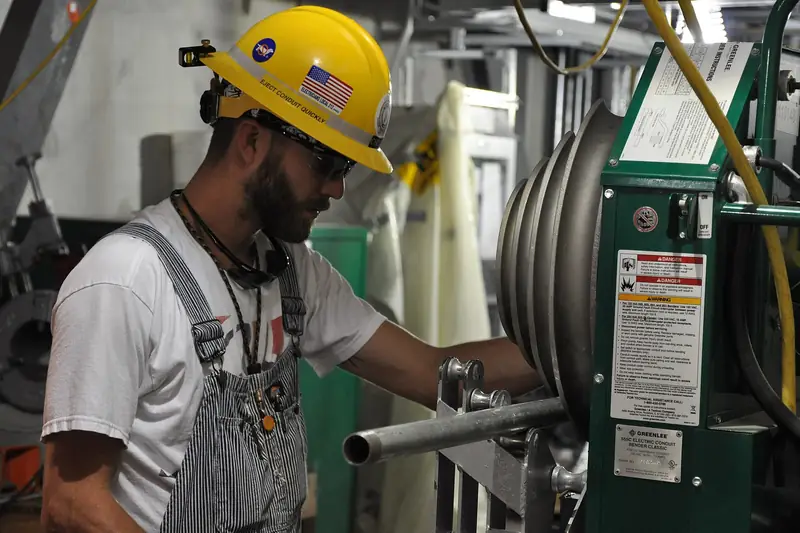
Photos: Electrician prepping conduit, PEO ACWA, CC BY 2.0. All photo credits.
