

Welding: the work, the crew, how to get on
Updated
The Good
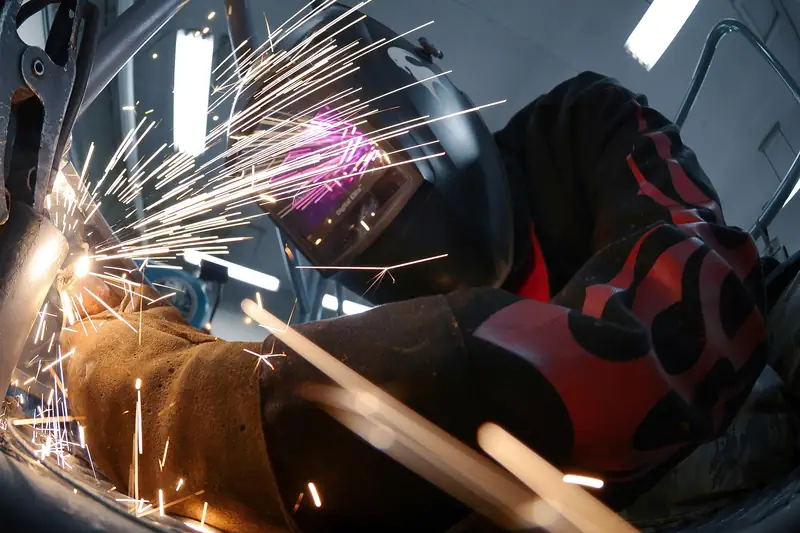
A weld is a promise that has to hold under load. Welders earn their name one bead at a time.
- Welders and related workers use hand-held or remotely controlled equipment to join or cut metal parts. 3
The work keeps coming: BLS projects employment to grow 2.4% from 2025 to 2035, with about 40,300 openings a year 2
If you served
Military jobs that map here 5
- Army MOS: 44B Metal Worker
- Navy rating: SW Steelworker; HT Hull Maintenance Technician
- Air Force AFSC: 2A7X1 Aircraft Metals Technology; 3E3X1 Structural
- Marine Corps MOS: 1316 Metal Worker
- Coast Guard rating: DC Damage Controlman; AMT Aviation Maintenance Technician
- Space Force SFSC: 2A7X1 Aircraft Metals Technology
Is it for you?
You fit if you have steady hands, patience and the eyes to read a puddle. Booth practice is lonely, and the men who get good put in hours on their own.
A day on the crew
A typical day as crews describe it. Every outfit runs its own way.
- Morning starts with the plan or the print, and checking machines, leads and gas.
- Fit-up comes first. The pieces have to be clean, square and tacked before you run a bead.
- Root pass, hot pass, fill and cap. You chip slag between passes and look at each one.
- Some jobs get a visual check, some get tested. Either way, the weld has your name on it.
- End of the shift: leads coiled, rod stored dry and the area swept of hot scraps.
A weld that holds keeps a bridge, a tank or a trailer safe for somebody's family down the road.
The rods, the wire and the test
Stick (SMAW)
The rod and the stinger. Stick still runs in wind that would blow shielding gas off the puddle, which is why yard, structural and field crews keep it close. Learn to strike an arc without freezing the rod, hold a tight arc length and chip and wire-brush every bit of slag between passes.
MIG (GMAW) and flux-core (FCAW)
Wire feeds through the gun from a spool. MIG is the shop and production workhorse; flux-core makes its own shielding and handles a breezy yard. Both are quick to pick up, and both make it easy to lay a bead that looks pretty and never fused into the base metal. That is exactly what a good foreman cuts open to check.
TIG (GTAW)
Tungsten in the torch, filler rod in the other hand, a pedal under your foot. Slow, clean and unforgiving, it shows up on stainless, aluminum and the root pass on pipe. Steady hands and patience get paid here.
Positions
Tests are named by position: 1G flat, 2G horizontal, 3G vertical and 4G overhead on plate, with F in place of G for fillet welds. On pipe, 6G means the pipe is fixed at an angle and you weld every position in one joint. Vertical-up and overhead are where a greenhorn earns the burns on his neck.
The bend test
Plenty of shops test you before they hire you. You weld a coupon, it gets cut into strips and bent around a mandrel, and if the weld cracks open, you do not get the job that day. Structural shops commonly test to AWS D1.1 and pressure piping to ASME Section IX. Ask which code the shop works to and practice that joint the night before.
Fit-up before you strike
Most bad welds start before the arc. Grind mill scale and rust back to bright metal, set the gap and the land, tack it square and check it twice. A good fitter makes a welder look good, and many welders started out as the helper grinding and fitting for somebody else.
Protect what has to last forty years
Arc flash burns your eyes the way the sun burns skin, only faster, so keep the hood down and call out before you strike so the man beside you can look away. Fumes rise past the hood; keep your head out of the plume and run the fan or extraction. Wear leather and cotton, never synthetics that melt, and keep a fire watch on anything near combustibles.
Reading the weld symbol
The arrow on a print points at the joint, and the flag, triangle and numbers tell you the weld type, size and which side gets it. A fillet symbol below the line means the arrow side; above the line means the other side. Ask the lead to walk you through one print on your first week, then never guess again.
Shop, yard or field
Shop welders work under a roof on repeat parts and fixtures. Yard and structural hands weld beams, plate and stairs, often up in a lift with a harness on. Field and pipe welders chase the work with a rig truck, and the weather is part of the job. Pick the one that fits your back and your family, and know you can switch later.
The Brutal
Heat, sparks and fumes under the hood, bent over a joint for hours. Your back and your eyes pay the bill if you skip the gear.
- Welders may be exposed to fumes, very hot materials and intense arc light. 3
- Most work full time and some work more than 40 hours a week, so evenings and weekends are possible. 3
Crew safety talks for this trade: PPE · housekeeping. Free, with a printable sign-in sheet.
Greenhorn mistakes
- Running a bead over bad fit-up and hoping it holds.
- Not cleaning slag between passes.
- Striking an arc without the hood down and getting flash burn.
Hard lessons
Plenty of welders fail a test before they pass one. The test does not care how you feel. You go back to the booth, burn more rod and take it again. The bead that passes is built on the ones that did not.
The Paycheck
The spread: 10% of welders, cutters, solderers, and brazers earned under $39,240, 10% over $77,530 1 BLS does not publish starting pay, overtime or per diem, so neither do we. Get the rate and travel terms in writing.
U.S. pay, BLS OEWS May 2025 national estimatesOccupation · Median. Tap a row for the rest.
Welders, cutters, solderers, and brazers$53,750 ($25.84/hr)
- Median
- $53,750 ($25.84/hr)
- Bottom 10%
- $39,240
- Top 10%
- $77,530
- Jobs
- 416,210
- Code
- SOC 51-4121
Base wages 1
Where the pay runs highest
Top five states by median wage, BLS OEWS May 2025State · Median · vs U.S. median. Tap a row for the rest.
Alaska$80,840 · +50%
- Median
- $80,840
- vs U.S. median
- +50%
- Jobs
- 790
Hawaii$79,000 · +47%
- Median
- $79,000
- vs U.S. median
- +47%
- Jobs
- 520
Connecticut$64,880 · +21%
- Median
- $64,880
- vs U.S. median
- +21%
- Jobs
- 1,790
Wyoming$63,820 · +19%
- Median
- $63,820
- vs U.S. median
- +19%
- Jobs
- 1,850
Washington$63,020 · +17%
- Median
- $63,020
- vs U.S. median
- +17%
- Jobs
- 7,720
Of 51 ranked 1
How to Get In
Shops, fab yards and contractors test welders before they hire. Ask what process and position the test uses, then practice that exact joint.
Crews hire who they know. Here is how to get known and get hired.
What the foreman wants to see
- Your fit-up is clean before you ask for a check.
- You wear the gear every time, even for a quick tack.
- You pass the test the first time because you practiced on your own.
Before Monday, ask what the job needs: a license or permit, a safety card or site orientation, a drug screen. Gear: the Day One checklist.
- Entry typically takes a high school diploma or equivalent plus technical and on-the-job training; apprenticeships are another route. 3
- Welders must be licensed in some states and localities. 3
Apprenticeship sponsors
DOL lists 72 sponsors matched to this trade by name, most in Colorado 8, Texas 8, Missouri 6, Kentucky 4, Michigan 4. A place to start calling, not a job count 7
The path to owning your own outfit
A welder with his own truck rig can run mobile repair or fabrication work. That takes insurance, a rig you can pay for and a reputation for welds that pass. BLS puts the self-employed share of welders, cutters, solderers, and brazers at 4.3% in 2025 6. The full steps are on crew to owner.
Where the build is
Generators under construction and planned, by state (EIA-860M, Sept 2026)State · Building. Tap a row for the rest.
TX5,417 MW
- Units building
- 24
- Building
- 5,417 MW
- Units planned
- 182
- Planned
- 22,699 MW
WY3,550 MW
- Units building
- 4
- Building
- 3,550 MW
- Units planned
- 6
- Planned
- 1,130 MW
VA2,640 MW
- Units building
- 1
- Building
- 2,640 MW
- Units planned
- 4
- Planned
- 1,000 MW
NY2,109 MW
- Units building
- 11
- Building
- 2,109 MW
- Units planned
- 6
- Planned
- 506 MW
MS1,655 MW
- Units building
- 6
- Building
- 1,655 MW
- Units planned
- 16
- Planned
- 1,358 MW
Jobsite words
- Root pass
- The first weld pass at the bottom of the joint.
- Cap
- The final pass on top of the weld.
- Fit-up
- How the pieces are lined up and tacked before welding.
- Slag
- The crust left on top of a stick or flux-core weld.
More in the jobsite words glossary.
Questions people ask
How many people work as welders, cutters, solderers, and brazers?
BLS OEWS counted 416,210 in May 2025 (data released May 15, 2026).
What training does it take?
BLS lists the typical entry education as high school diploma or equivalent and the typical training as moderate-term on-the-job training (Employment Projections 2025-35).
How much do welders, cutters, solderers, and brazers make?
BLS OEWS reported a May 2025 median of $53,750 a year, or $25.84 an hour, with the bottom 10% at $39,240 and the top 10% at $77,530 (data released May 15, 2026).
What do greenhorns get wrong?
Running a bead over bad fit-up and hoping it holds. Not cleaning slag between passes. Striking an arc without the hood down and getting flash burn. Your fit-up is clean before you ask for a check.
Running a welding crew?
Featured hiring spots open soon; seekers apply straight to you.
Tell us you are hiringOther trades
Sources
- BLS OEWS, May 2025 data, released May 15, 2026
- BLS Employment Projections 2025-35, 2025-35 projections
- BLS Occupational Outlook Handbook: Welders, Cutters, Solderers, and Brazers, page dated Oct 29, 2026
- BLS OEWS, May 2025: national mean and 90th percentile annual wage, May 2025 data, released May 15, 2026
- O*NET OnLine Military Crosswalk, vintage Oct 30, 2026
- BLS Employment Projections Table 1.2, percent self-employed, 2025 data
- U.S. DOL Office of Apprenticeship partner sponsors, trades-core release Nov 4, 2026
- EIA Form EIA-860M, September 2026 inventory, released Oct 23, 2026
- Technology-to-trade mapping, Tough and Dirty (editorial, not an EIA or BLS product), Nov 2026
Estimates, not promises. Rules change; check with the employer and the agency.
Photos: Welder throwing sparks, Airman 1st Class David Owsianka, Public domain. All photo credits.
