

Roofing: the work, the crew, how to get on
Updated
The Good
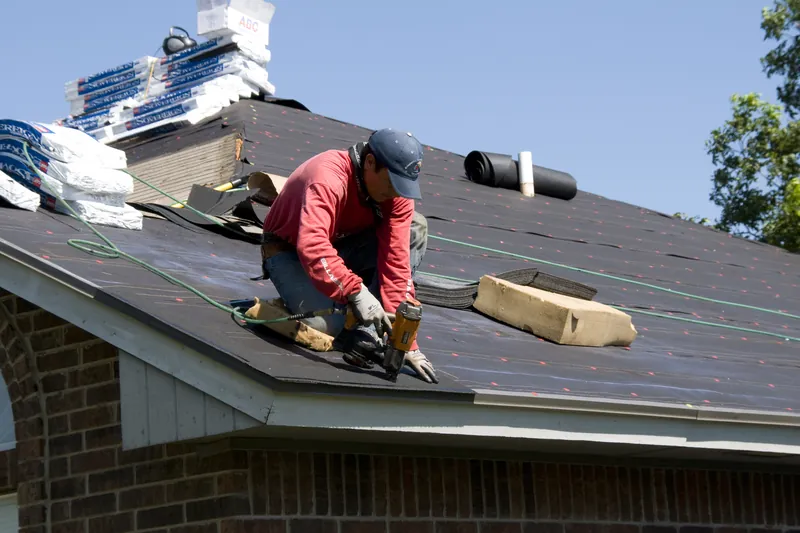
Roofers work up high and fast, shoulder to shoulder, in weather other trades wait out. Safe habits are what let the whole crew go home.
- Roofers replace, repair and install the roofs of buildings. 3
The work keeps coming: BLS projects employment to grow 5.3% from 2025 to 2035, with about 12,000 openings a year 2
Is it for you?
You fit if you are not afraid of heights, can handle heat and like hard work you can see at the end of the day. Fitness matters more here than in most trades.
A day on the crew
A typical day as crews describe it. Every outfit runs its own way.
- The crew arrives early to beat the heat. Ladders up, harness on and anchors set.
- Tear-off comes first: old shingles off, nails pulled and debris in the dumpster.
- Decking checked and replaced where it is rotten. Underlayment and drip edge go down.
- Starter course, then shingles or panels, row after row, with flashing at every wall and pipe.
- Magnet sweep for nails, final walk with the lead and a clean yard for the homeowner.
A dry roof is the first thing a family needs, and roofers see that in the faces of the people under it.
The Brutal
Hot shingles, steep pitches and heavy bundles up the ladder. The first week is hard on a greenhorn's knees and shoulders.
- The work is physically demanding, with climbing, bending, kneeling and heavy lifting, and roofers usually skip work in bad weather. 3
- Roofers may work overtime to finish jobs in the busy summer months. 3
- OSHA's general trigger: each employee on a walking/working surface with an unprotected side or edge 6 feet or more above a lower level must be protected by guardrails, safety nets or personal fall arrest. 5
- Paragraph (b)(13) covers employees in residential construction activities 6 feet or more above lower levels, who need guardrails, safety nets or personal fall arrest unless another provision allows an alternative. 6
Crew safety talks for this trade: fall protection · heat stress. Free, with a printable sign-in sheet.
Greenhorn mistakes
- Not tying off because the roof looks flat enough.
- Carrying too many bundles up the ladder.
- Leaving nails in the driveway.
Hard lessons
Every roofer has had a bad first week. The heat and the pitch humble a man fast. The ones who come back on Monday and keep at it are the ones who end up running crews.
The Paycheck
The spread: 10% of roofers earned under $37,460, 10% over $81,720 1 BLS does not publish starting pay, overtime or per diem, so neither do we. Get the rate and travel terms in writing.
U.S. pay, BLS OEWS May 2025 national estimatesOccupation · Median. Tap a row for the rest.
Roofers$55,440 ($26.65/hr)
- Median
- $55,440 ($26.65/hr)
- Bottom 10%
- $37,460
- Top 10%
- $81,720
- Jobs
- 135,490
- Code
- SOC 47-2181
Base wages 1
Where the pay runs highest
Top five states by median wage, BLS OEWS May 2025State · Median · vs U.S. median. Tap a row for the rest.
Illinois$77,900 · +40%
- Median
- $77,900
- vs U.S. median
- +40%
- Jobs
- 5,300
New Jersey$76,600 · +38%
- Median
- $76,600
- vs U.S. median
- +38%
- Jobs
- 1,860
Minnesota$74,490 · +34%
- Median
- $74,490
- vs U.S. median
- +34%
- Jobs
- 1,890
Massachusetts$72,750 · +31%
- Median
- $72,750
- vs U.S. median
- +31%
- Jobs
- 1,950
Alaska$66,750 · +20%
- Median
- $66,750
- vs U.S. median
- +20%
- Jobs
- 310
Of 51 ranked 1
How to Get In
Roofing crews often hire laborers who can start right away. Show up ready to carry and to learn tear-off first.
Crews hire who they know. Here is how to get known and get hired.
What the foreman wants to see
- You tie off without being told.
- You keep the ground and the roof clean as you go.
- You work steady all day, not fast for an hour.
Before Monday, ask what the job needs: a license or permit, a safety card or site orientation, a drug screen. Gear: the Day One checklist.
- No formal education is typically required; training is on the job, and a few groups sponsor apprenticeships. 3
- Most employers require roofers to complete safety certification. 3
Apprenticeship sponsors
DOL lists 142 sponsors matched to this trade by name, most in New York 10, Ohio 10, California 9, Illinois 9, Texas 8. A place to start calling, not a job count 8
The path to owning your own outfit
Roofing is one of the trades on this site where a large share of workers are self-employed (the BLS figure is below). Some states license roofing contractors. BLS puts the self-employed share of roofers at 19.8% in 2025 7. The full steps are on crew to owner.
Jobsite words
- Square
- One hundred square feet of roof.
- Tear-off
- Removing the old roof down to the deck.
- Flashing
- Metal that seals walls, chimneys and pipes against water.
- Starter course
- The first row along the eave that the rest of the roof sits on.
More in the jobsite words glossary.
Questions people ask
How many people work as roofers?
BLS OEWS counted 135,490 in May 2025 (data released May 15, 2026).
What training does it take?
BLS lists the typical entry education as no formal educational credential and the typical training as moderate-term on-the-job training (Employment Projections 2025-35).
How much do roofers make?
BLS OEWS reported a May 2025 median of $55,440 a year, or $26.65 an hour, with the bottom 10% at $37,460 and the top 10% at $81,720 (data released May 15, 2026).
What do greenhorns get wrong?
Not tying off because the roof looks flat enough. Carrying too many bundles up the ladder. Leaving nails in the driveway. You tie off without being told.
Running a roofing crew?
Featured hiring spots open soon; seekers apply straight to you.
Tell us you are hiringOther trades
Sources
- BLS OEWS, May 2025 data, released May 15, 2026
- BLS Employment Projections 2025-35, 2025-35 projections
- BLS Occupational Outlook Handbook: Roofers, page dated Sep 14, 2026
- BLS OEWS, May 2025: national mean and 90th percentile annual wage, May 2025 data, released May 15, 2026
- OSHA, 29 CFR 1926.501 Duty to have fall protection, checked Nov 19, 2026
- OSHA, 29 CFR 1926.501, checked Nov 19, 2026
- BLS Employment Projections Table 1.2, percent self-employed, 2025 data
- U.S. DOL Office of Apprenticeship partner sponsors, trades-core release Nov 4, 2026
Estimates, not promises. Rules change; check with the employer and the agency.
Photos: Roofer in Norman, Oklahoma, Patsy Lynch, Public domain. All photo credits.
